Press Release
October 1, 2026
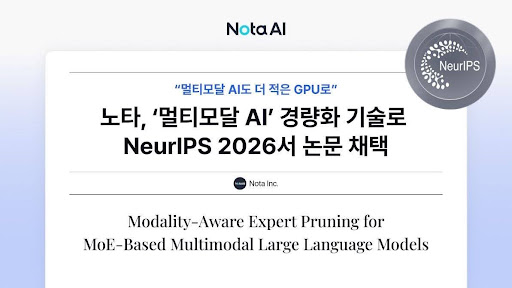
Nota AI, an AI model compression and optimization technology company, announced that its research on reducing GPU memory requirements for multimodal AI models while preserving model performance has been accepted to the main track of NeurIPS 2026, one of the world’s leading AI conferences.
The paper, titled “Modality-Aware Expert Pruning for MoE-Based Multimodal Large Language Models,” introduces an expert pruning method designed specifically for multimodal AI systems that process both text and visual inputs. The approach removes less critical expert modules from Mixture-of-Experts (MoE) models while accounting for their respective contributions to language and visual understanding.
In evaluations on a multimodal model with approximately 31 billion parameters, Nota AI’s method preserved 98% of the original model performance after removing 25% of expert modules, and 91% after removing 50%. GPU memory usage was reduced from 58GB to 31GB, a reduction of approximately 47%, enabling the model to run on a single GPU with 40GB of memory.
The results show that deploying advanced AI models does not always require adding more high-end GPUs. By reducing the memory required to run a model, software optimization can help enterprises make better use of existing AI infrastructure. This can allow companies to deploy a broader range of models on the same GPU resources or allocate available capacity to additional models and services.
MoE architectures activate only a subset of expert modules for each input, but the full set of experts must still be stored in memory. As models grow larger, this creates a significant deployment burden. Expert pruning reduces that burden by removing experts with relatively low importance.
However, pruning methods developed for text-only language models do not always translate well to multimodal AI. Experts that appear less important for text may still play a critical role in visual understanding. In Nota AI’s experiments, this issue was particularly visible in tasks such as chart comprehension, where removing visually important experts led to substantial performance degradation.
To address this, Nota AI evaluates expert importance separately for text and image inputs. Text-based importance is used to identify experts that should be retained, while image-based importance helps determine which experts can be removed. The method also compares experts across the full model rather than pruning the same number from every layer, helping preserve experts in layers where they are more important.
Another key advantage is that the method requires no additional model training. Compression can be completed in a single pruning process based on a user-defined pruning ratio, allowing the approach to be applied quickly as new foundation models are introduced.
Nota AI plans to integrate the technology into NetsPresso®, its AI optimization platform, to strengthen support for multimodal and MoE models. As AI systems continue to expand beyond text into images, video and audio, the company expects the technology to broaden the range of models and customer use cases supported by the platform.
The research also strengthens Nota AI’s ability to optimize not only large language models but also vision-language models. The underlying principle of evaluating expert importance by input modality may also be extended to additional modalities such as video and audio.
Nota AI has previously applied expert pruning techniques to large-scale models including Kimi K3 and Solar Open 2. With research recognized this year at ICLR, EMNLP, ICML and now NeurIPS, the company continues to expand its technical capabilities in AI model optimization.
“As AI evolves from text-centric language models toward multimodal systems that understand images, video and audio, model size and GPU memory requirements are increasing rapidly,” said Myungsu Chae, CEO of Nota AI. “This research is meaningful because it shows that we can significantly reduce the computing resources required to run these models while preserving performance, helping improve the efficiency of real-world AI infrastructure.”
“Nota AI is extending the optimization expertise we have built for large language models into multimodal AI, and we continue to incorporate our latest research into NetsPresso®,” Chae added. “As AI models become larger and more complex, optimization will become increasingly important for helping enterprises make more efficient use of the GPU and AI infrastructure they already have.”