Press Release
September 23, 2026
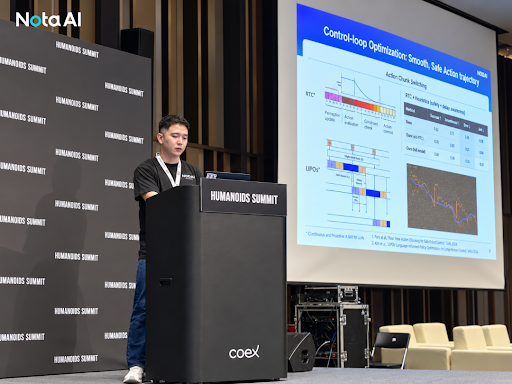
Nota AI, an AI model compression and optimization technology company, announced that it presented new robot AI optimization results at Humanoid Summit Seoul 2026, demonstrating its ability to optimize seven robot AI models across both Qualcomm NPU- and NVIDIA GPU-based environments using its AI optimization platform, NetsPresso®.
Across different model and hardware combinations, Nota AI accelerated inference by up to 7× while keeping task success rates within 1 percentage point of the original models. In physical robot testing, the optimized system also improved robotic arm task speed by 3×. The results demonstrate how hardware-aware optimization can broaden the range of model and processor choices available for different robotic applications and operating conditions.
At the event held at COEX in Seoul, Geonmin Kim, AI Researcher at Nota AI, presented a session titled “Optimizing Robot Foundation Models Across Diverse Hardware Environments with NetsPresso®.” The session covered optimization techniques for deploying robot AI models on edge devices, along with performance results from real-world and simulated testing.
Nota AI presented optimization results on two hardware platforms: the Qualcomm Dragonwing IQ-9075 processor and NVIDIA’s GPU-based edge AI platform, Jetson Thor. The evaluation covered seven robot AI models, including NVIDIA GR00T N1.7 and Cosmos 3 Edge, Physical Intelligence’s π0.5, Hugging Face’s SmolVLA, as well as MolmoAct2, X-VLA and VLA-JEPA.
For GR00T N1.7, Nota AI reduced inference time from 1,602 milliseconds to 228 milliseconds, delivering approximately a 7× speedup. In physical robotic arm testing, task execution speed improved by 3×. On LIBERO, a simulation benchmark for robotic task performance, the optimized model achieved a 92% task success rate compared with 93% for the original model, maintaining performance within 1 percentage point while significantly reducing the time required for the robot to determine its next action.
On NVIDIA Jetson Thor, Nota AI reduced the inference time of Cosmos 3 Edge from 1,711 milliseconds to 739 milliseconds, delivering an approximately 2.3× speedup. On the RoboLab simulation benchmark, the optimized model maintained the original model’s task success rate.
Vision-language-action (VLA) models combine visual perception, language understanding and action generation to determine how a robot should respond to its environment. Deploying these models on physical robots requires more than task accuracy alone. Inference latency, memory usage and hardware constraints are also critical, particularly because different models use different architectures and computation patterns, while each processor has its own execution characteristics.
NetsPresso® addresses these challenges by optimizing both the AI model and its target runtime environment. The platform reduces computational and memory requirements while adapting execution to the characteristics of the target hardware to improve real-world performance. This enables developers to select models based on the robot’s task requirements and deploy them more efficiently across different hardware platforms.
Nota AI is expanding its optimization capabilities, built across mobile, edge and data center environments, into robotics, humanoids and the broader physical AI market. The company plans to continue advancing optimization technologies across a wider range of robot AI models and hardware platforms to support practical AI deployment on physical devices.