Product
NetsPresso is a blend of Neural Nets and Espresso. Just as pressing coffee beans hard pulls a rich shot of espresso, the name carries the idea of compressing a large AI model to condense its performance onto a small device.
Until now, NetsPresso was like a well-built semi-automatic espresso machine. It removed the fuss of pour-over, where you set up every fragmented tool by hand, but pulling the perfect cup still took an expert's touch. Just as grind size, tamping pressure, and extraction time decide the taste of the coffee, the final performance came down to how finely you combined a great many variables.
But the new Agent feature has turned NetsPresso into a fully automatic machine.
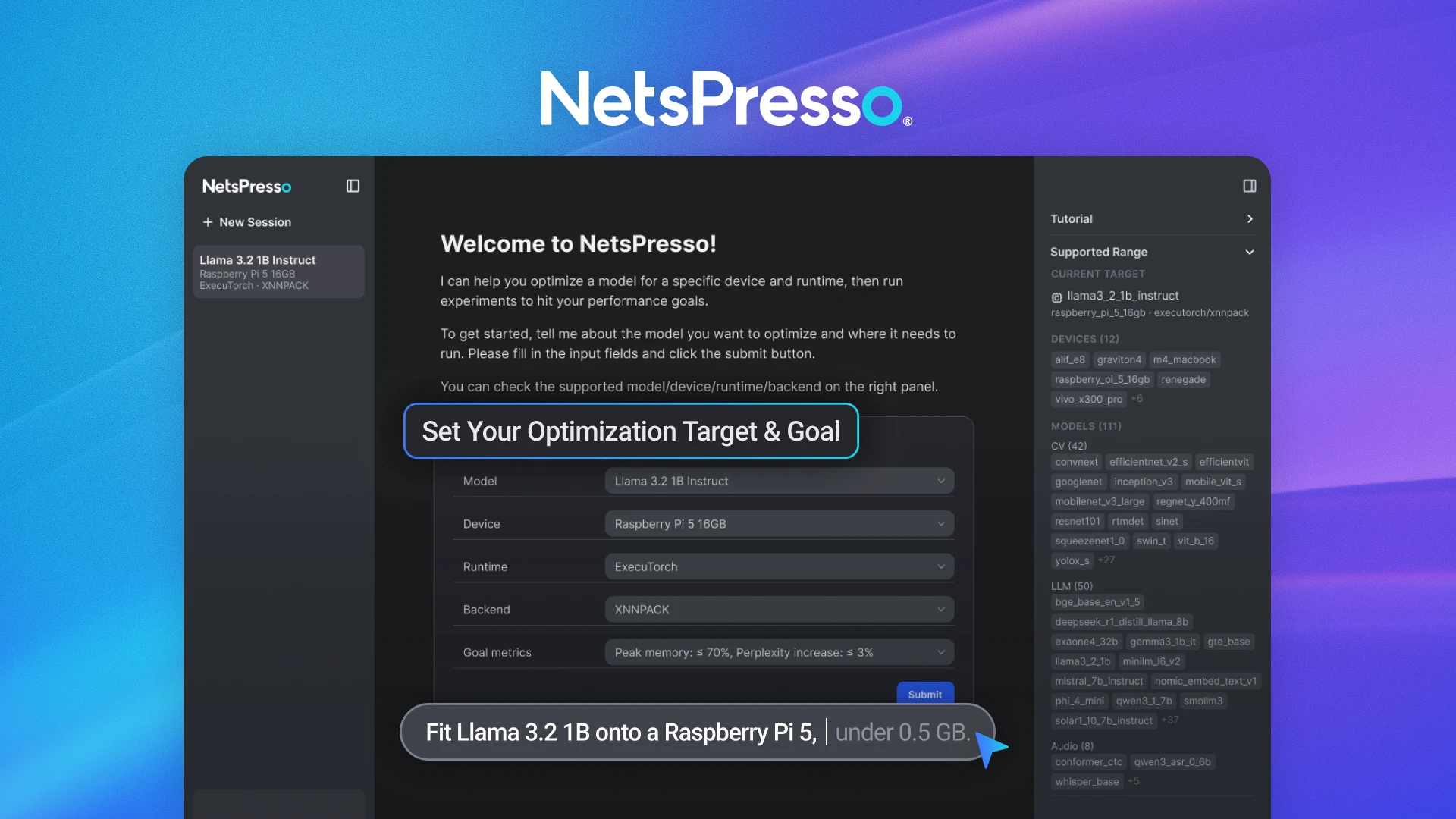
Now you just state the model, the target device, and the performance you want. Like a machine that reads the beans on its own and finds the best way to pull the shot, NetsPresso proposes the ideal optimization recipe. Ask for "a little lighter," and it revises the recipe on the spot and pulls the model again.
We called the old NetsPresso a semi-automatic machine because it was a CLI (Command Line Interface) tool, and setting the parameters was entirely the user's job. You opened a config file, wrote in which quantization algorithm to use and which bit combination to go with, and ran it yourself. That was a deliberate choice. Dropping it straight into an existing dev environment, wrapping it in scripts for automation, and putting it under version control like Git is the most powerful and familiar way to work for an engineer.
But the way developers work has shifted. Explaining a goal to an AI agent and then reviewing and judging what comes back now takes up far more of the job than typing out code line by line. A model optimization pipeline is no exception.
You no longer have to open a YAML file and rework its structure. You just toss out what you want in plain, everyday language.
I want to run Llama 3.2 1B on a Raspberry Pi 5. Keep it above 10 tokens per second, and get the model under 0.5 GB.
The agent reads this request as a structured optimization goal. It identifies the model and the target device, works out which runtime and backend to pair, and decides which metrics (throughput, model size, quality) to hit and to what level. If something is missing, it comes back and asks.
Once you check the result and give feedback like "keep the accuracy, but shrink the size a bit more," the agent immediately finds a new recipe for that request and pulls the model again.
Better usability means nothing if the results do not follow. The module that backs the performance behind that easier experience is HPO (Hyper-Parameter Optimization).
Optimizing a model comes down to finding the best combination within a vast set of choices. Take quantization alone. You have to decide which algorithm to apply, how to assign the bit widths for weights and activations, and how to set that combination differently for each layer of the model.
With every added variable, the search space quickly grows beyond what any person can scan by hand. So until now, the experience of a skilled engineer led this search. An eye for the right combination was, in effect, the performance of the result.
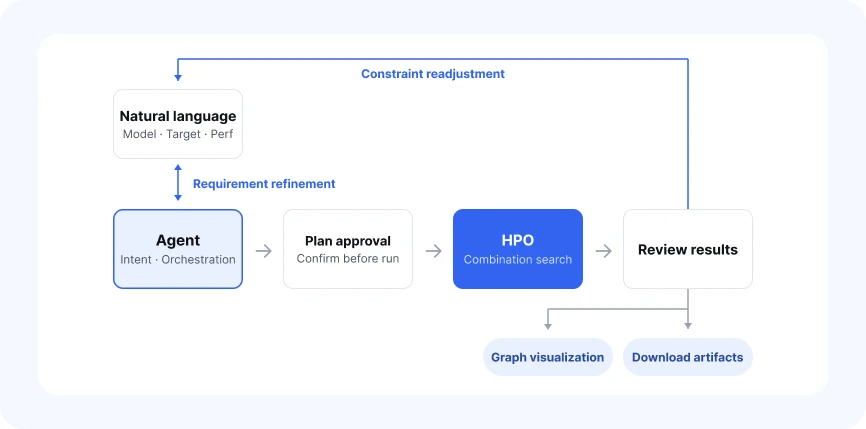
HPO takes the search that experts used to narrow down from experience and metrics, and moves it into an algorithm. When HPO receives the goal the agent extracted from natural language, it sets out to find the combination that can meet those criteria.
It does not blindly try every possibility. Using the results of earlier trials, it gauges the promising points to examine next and narrows the range, reaching the target performance quickly within a limited number of trials. If the agent takes your input and coordinates the whole process, the HPO algorithm is what actually finds the best recipe underneath it.
"Why not just use a general-purpose AI agent?" you might ask. Today's AI agents are advanced enough to plan on their own and use tools to reach even complex goals. But in a specialized domain like AI model optimization, there are still limits. Along the way an agent can try an unsupported hardware combination, or hit a silent failure, where an operation is dropped from the model, and read it as success before carrying on to the next step. That is where high autonomy shows its blind spots.
NetsPresso constrains the agent's problem-solving to run only within pre-verified actions and a validation policy. Pairing the distinctive flexibility of a general-purpose agent with guardrails is what secures reproducibility, which matters most in day-to-day enterprise work.
Now to the actual results. The test subjects are computer vision (CV) classification models. We compared what the NetsPresso HPO module found against an existing benchmark that an expert had optimized by hand. The optimization tools and evaluation conditions were all held identical; the only difference was whether a person set the parameters by hand or HPO searched for them automatically. The search was capped at 40 trials per model.
Across four of the five models in the comparison, HPO reproduced the same level of accuracy as the expert's hand-tuned result. On mobilenet_v3_large, HPO was actually 1.67pp higher, and resnet18 and googlenet matched within 0.2pp. resnet50 came out identical down to the decimal, and the remaining model (squeezenet1_0) gave up 1.41pp of accuracy in exchange for faster speed.
.webp)
What these numbers point to is clear: an algorithm-driven automatic search reproduced, quickly and reliably, the optimum that experts used to reach only after long experience and trial and error. This matters most for teams that cannot dedicate staff to optimization, or that have to move quickly every time a new model appears.
NetsPresso is now a tool where you only have to state the goal. It has moved from a semi-automatic machine, where you dialed in grind, tamping, and extraction time one by one, to a fully automatic machine that pulls an expert's cup at the press of a button. Here is what that change actually amounts to, in three points.
See for yourself in a demo how much easier optimization has become, and how much of the time you used to spend on repeated experiments you get back.

Note: The benchmark figures in this article are results from one specific combination of model, hardware, and settings. Actual performance may vary depending on your environment.