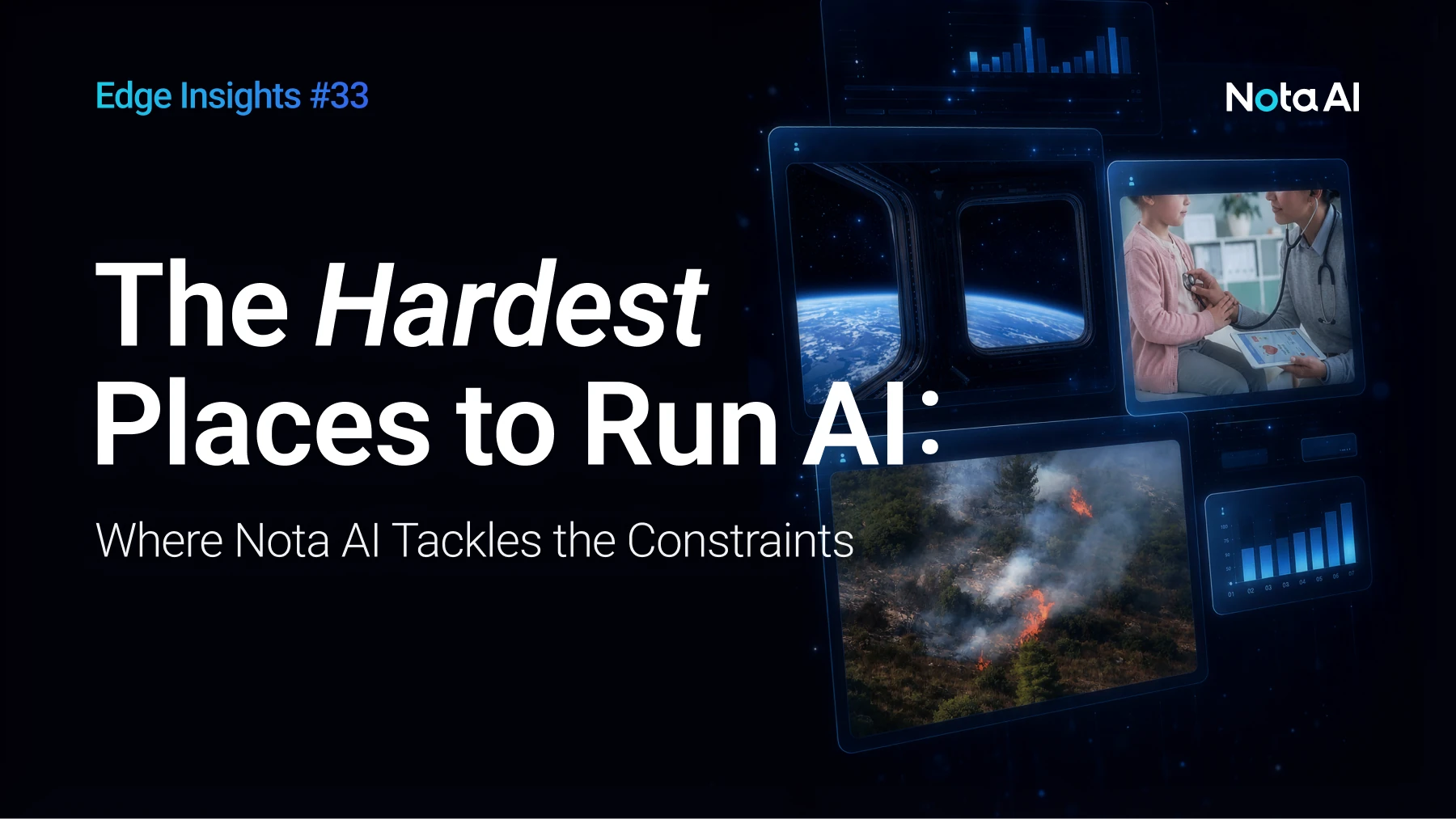
🔹 The Question Real-World Industries Are Asking
🔹 The Resource Constraint — Autonomous Experiments in Space Pharmaceuticals
🔹 The Time Constraint — Generative Vision for Disaster Broadcasting
🔹 The Access Constraint — Pediatric Respiratory Diagnosis on a Smartphone
🔹 One Foundation, Endless Frontiers
The center of gravity in AI is shifting from training large models to running them. As demand for AI memory grows, production is concentrating on high-bandwidth memory (HBM), putting pressure on the price and supply of general-purpose memory. How you build a model now matters just as much as how you run it reliably under constrained compute, power, and memory.
This pressure only grows as Physical AI and Agentic AI move to the center of the industry's agenda. AI connected directly to the physical world — robots, vehicles, sensors, industrial equipment — demands low latency and reliable execution, while AI that reasons and acts across multiple tools and models has to absorb repeated inference costs and response times to stay sustainable at scale. As resources grow scarcer and demands grow heavier, how a model runs is no longer the concern of a specific technical domain — it is a shared challenge for anyone scaling AI in real-world environments.
On-device AI is the core answer. It means making models smaller and faster, optimizing them for their deployment environments, and designing the whole system from an HW-SW extreme co-design perspective — capabilities that are becoming a prerequisite for scaling AI into real products and services.
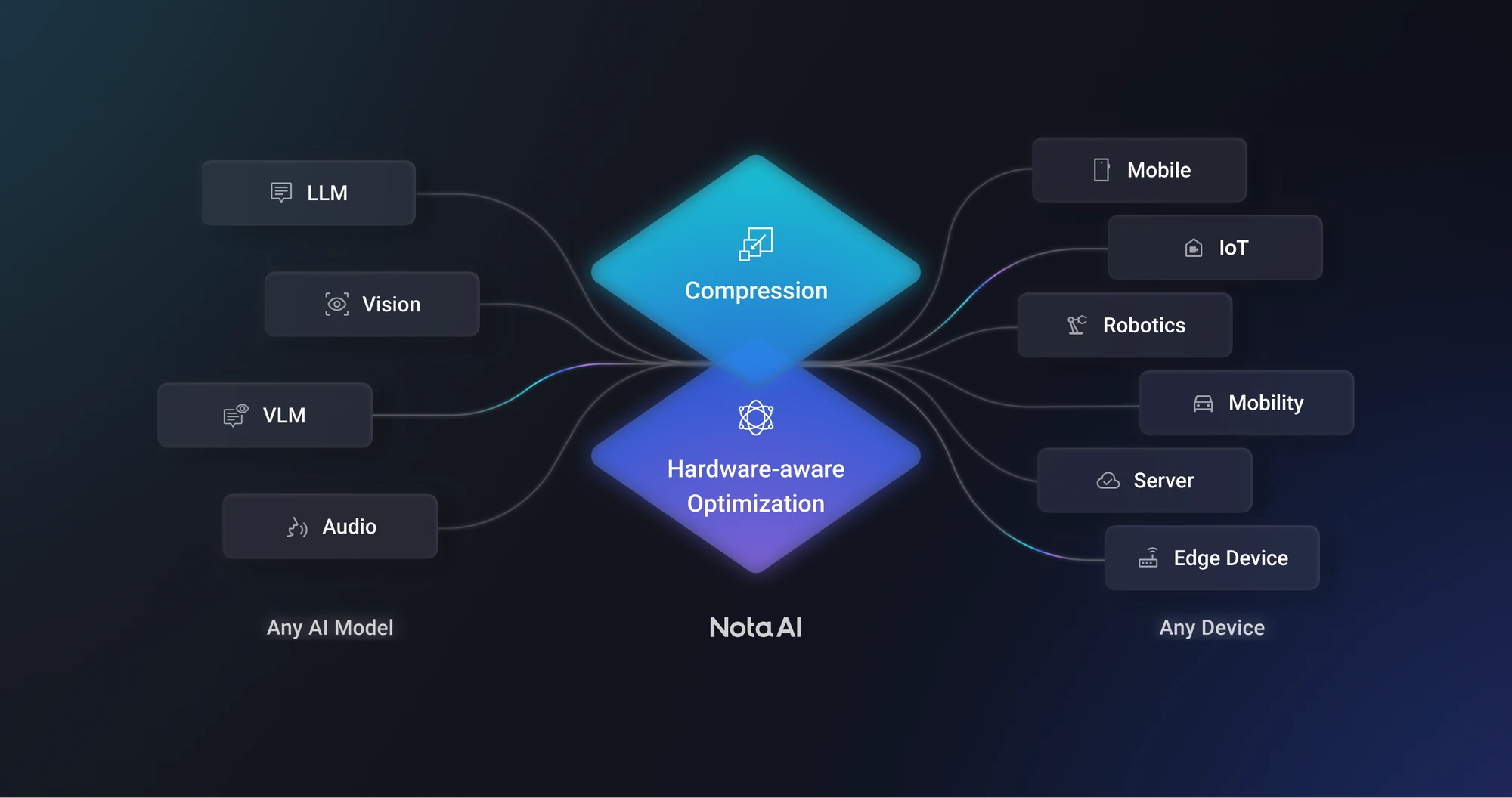
Nota AI has been solving this exact problem from the start. To run high-performance AI on devices where power, memory, and compute are scarce — smartphones, vehicles, CCTV cameras— Nota AI built up model optimization and hardware-specific optimization techniques into NetsPresso®, and proved that capability with global fabless and big-tech partners including Samsung Electronics' next-generation mobile AP and FuriosaAI's NPU. On-device AI optimization is what Nota AI does best.
And the constraint Nota AI solves comes in more than one form. Some environments lack the power and compute to carry a heavy model at all; some cannot afford to waste time, because a judgment translates immediately into action; and in some, a capable AI runs only inside specialized equipment and cannot reach a wider set of users. Even with the same optimization technology, the nature of the value it creates changes entirely depending on which constraint it is solving.
In this issue, we look at three real-world cases where those constraints stand out: space pharmaceuticals in orbit, where resources are limited; disaster broadcasting, where time is the decisive variable; and pediatric diagnosis, extended beyond specialized equipment onto the smartphone. Three very different fields, all operating on the very problem Nota AI has always solved — getting AI to work in constrained environments. Follow the constraint that most sharply defines each case, and the sheer breadth of where on-device AI can reach comes into view.
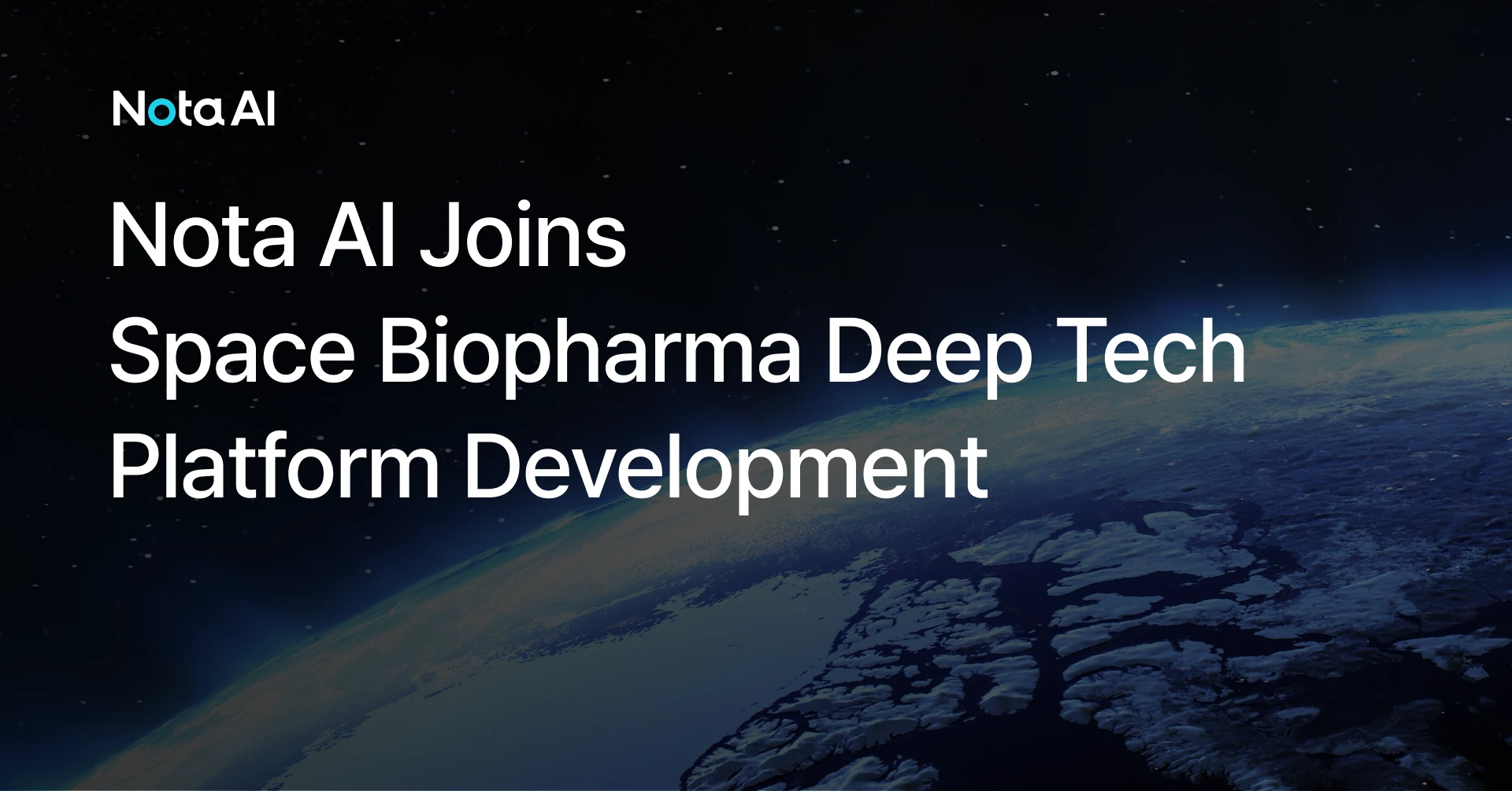
The first constraint is the most physical: a shortage of power, compute, and the hardware to run them. Nowhere is this constraint more extreme than space. Communication windows are intermittent, power is rationed, compute is scarce, and thermal budgets are tight — which makes the conventional cloud-AI pattern of shipping raw data elsewhere for analysis structurally unworkable. Whatever judgment the system needs has to happen on-site.
This is precisely the environment Nota AI is entering. Nota AI has joined the Deep-tech Challenge Project (DCP) led by SpaceLiinTech — a four-year national initiative, supported by Korea's Ministry of SMEs and Startups and TIPA, to build an autonomous experiment platform for manufacturing pharmaceuticals in microgravity aboard the International Space Station and in low Earth orbit. In microgravity, the convection, sedimentation, and buoyancy caused by gravity on the ground are reduced, opening new possibilities for protein crystallization and biopharmaceutical manufacturing. The challenge is running those experiments autonomously in orbit, without human intervention.
It is in that gap that on-device AI becomes not a feature but the enabling layer. Nota AI's role in the project is to develop the edge intelligence that lets the experiment platform interpret its own state: recognizing experiment status from video and sensor data, detecting anomalies the moment they arise, and summarizing what matters in natural language to report back to the ground.
Achieving this on the limited hardware that survives a launch and operates in orbit demands aggressive model compression and optimization — running capable models on a fraction of their original compute and memory, reliably, in a setting where a failed inference cannot simply be retried from the ground. With communication, power, and compute all constrained, space is an environment where AI has to operate autonomously, right where it is — making it the field where the need for on-device AI optimization shows up most clearly. It is the same optimization capability Nota AI built across mobile, autonomous driving, and robotics — now extended all the way into orbit.
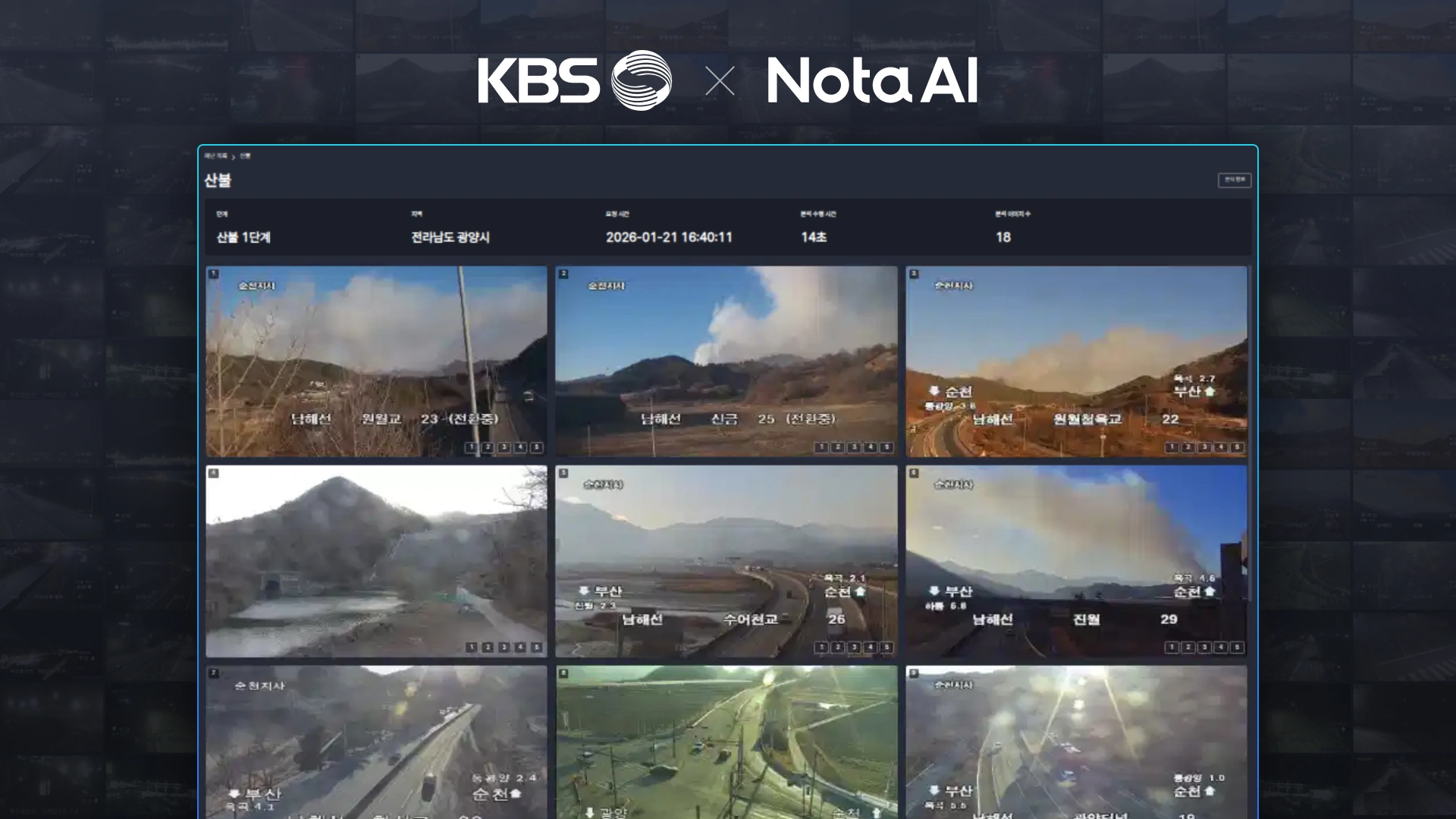
One of the constraints that matters most on the ground is time. In environments where a judgment translates immediately into action, the faster the analysis and response, the greater the value. Disaster broadcasting is the archetype. When a disaster strikes, Korea's public broadcaster KBS faces a problem conventional video analytics was never built to solve. The task is not to detect a predefined object in a frame, but to decide which of a flood of incoming CCTV feeds is fit to broadcast — a qualitative judgment closer to what an experienced journalist evaluates as broadcast suitability. A detection model outputs category labels; it cannot weigh whether a scene conveys a situation clearly enough to put on air. Until now, that selection was done manually, frame by frame — which risks losing the golden window when information needs to reach people fast.
Through KBS's "Disaster CCTV AI Dataset and Video Analysis Enhancement" project, Nota AI rebuilt this workflow around NVA (Nota Vision Agent) as its core engine. Rather than classifying objects, NVA runs a high-performance vision-language model (VLM) efficiently enough to interpret a scene in context, automatically ranks footage by broadcast suitability, and attaches a brief rationale to each ranking — a form of output a rule-based detector simply cannot produce. The harder engineering challenge is doing this reliably at peak load. Disasters create sudden surges of footage, and that is precisely the moment the system cannot afford to stall. NVA is engineered to run continuously through those data surges, analyzing large image batches within tens of seconds. In internal testing on a wildfire dataset, the scenes NVA selected showed high agreement with the footage reporters independently judged broadcast-suitable.
What makes the system operationally durable is the reporter feedback loop. Journalists rate NVA's selections through a structured interface, and those ratings flow back as a continuous improvement signal — so the system's notion of "broadcast-suitable" sharpens against real editorial judgment over time. Under acute time pressure, NVA hands reporters a structured first pass with reasoning attached, compressing an overwhelming manual review into a workable shortlist. That saved time helps deliver the information people need more quickly, and it marks a case of on-device AI optimization commercialized into the broadcast-media domain.
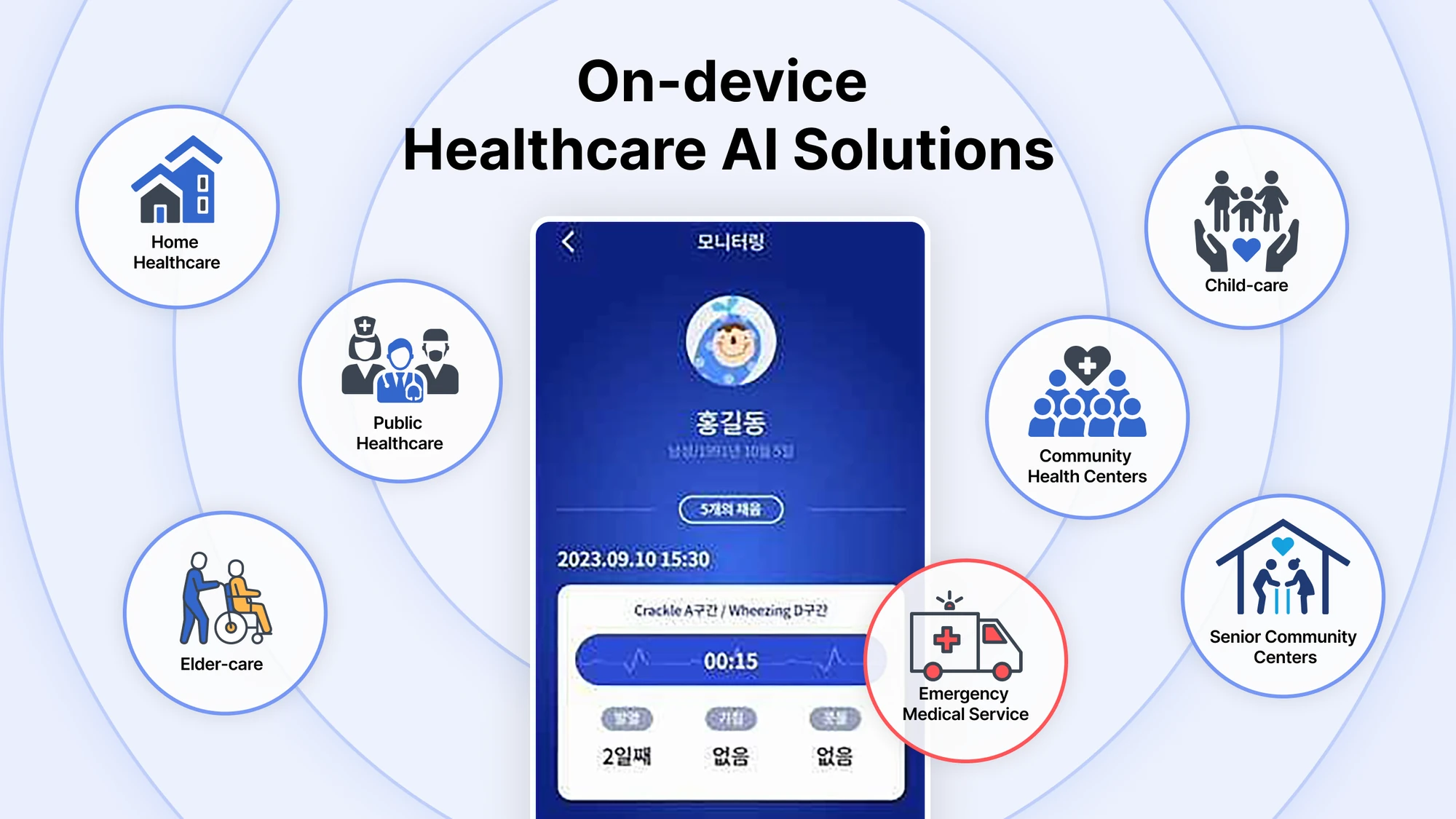
The third constraint is access to the technology itself. Respiratory illness urgently needs early detection, yet it is hard to assess objectively. It ranks among the leading causes of death in young children and the elderly, yet the conventional tool for gauging their respiratory state — the stethoscope — is inherently subjective. Auscultation depends on the listener's skill and hearing, the sounds are never permanently recorded for later analysis, and standardization across clinicians is difficult. The problem is especially acute in pediatrics, where respiratory-sound data for children under ten is so scarce that there is little ground truth to build objective analysis on.
Nota AI worked through this problem with Seongbuk Woori Children's Hospital. A pediatric hospital with roughly 500,000 patient visits a year, it provided the clinical scale needed to refine and standardize a model for distinguishing abnormal pediatric breathing sounds. The resulting solution completed clinical validation at over 86% accuracy, with the collected respiratory-sound data cross-checked against the hospital's clinical records to confirm real diagnostic value. The most distinctive element, technically, is the sensing method: rather than the airborne breath sounds a stethoscope captures, the model detects respiratory abnormalities from the vibration conducted through the body.
This is where the constraint Nota AI solved comes into focus. Nota AI's optimization compressed that high-performance model to run not on specialized medical equipment, but directly on a smartphone — the device almost everyone already carries — as an app. The moment diagnosis is freed from specialized hardware and brought down onto a general-purpose device, its reach fundamentally changes. Once a respiratory-screening model runs on a phone in nearly everyone's pocket, it stops being a single hospital tool and becomes a platform: a path toward remote care, home respiratory monitoring, and elderly-care settings, and toward regions where medical infrastructure is thin and a smartphone may be a viable diagnostic touchpoint. The validation marks a step in Nota AI's move from a technology company to one that solves real problems on the medical front line.
Resources, time, access. The autonomous experiment in orbit, the footage selection in a disaster control room, and the respiratory diagnosis in the palm of your hand each resolve a different constraint in a different way — the limits of resources, the limits of time, and reaching a wider set of users beyond specialized equipment. Yet the foundation beneath all three is the same: Nota AI's ability to make AI light and efficient enough to work exactly where it is needed.
That is what makes the range so striking. Had the constraint on-device AI solves been of a single kind, its applications would have stayed in a single lane. But each time the constraint branches — from resources to time, from time to access — a new domain opens where the technology can create value. NetsPresso® is how foundation models reach robots, vehicles, and embedded systems; NVA is how generative vision reaches the camera layer. Whether the deployment is a microgravity lab, a broadcast workflow, or a consumer smartphone, the same core optimization technology carries across all of them. Wherever the physical world poses a hard problem under real constraints, that is an opening for Nota AI — and there are far more of those frontiers ahead than behind.
.png)
🔹 2026 Korea AI Industry Awards — Nota AI received the Deputy Prime Minister & Minister of Science and ICT Award, the top honor at the awards.
🔹 KCC 2026 — June 24–26, ICC Jeju — Nota AI successfully co-hosted the On-Device AI Optimization Competition Powered by NetsPresso® with KIISE.
%20(1)%20(2).png)
🔹 Korea Efficient Days @ ICML 2026 — July 7 (Tue) Korea Efficient Night & July 8–9 (Wed–Thu) Open Office Day, alongside ICML 2026.