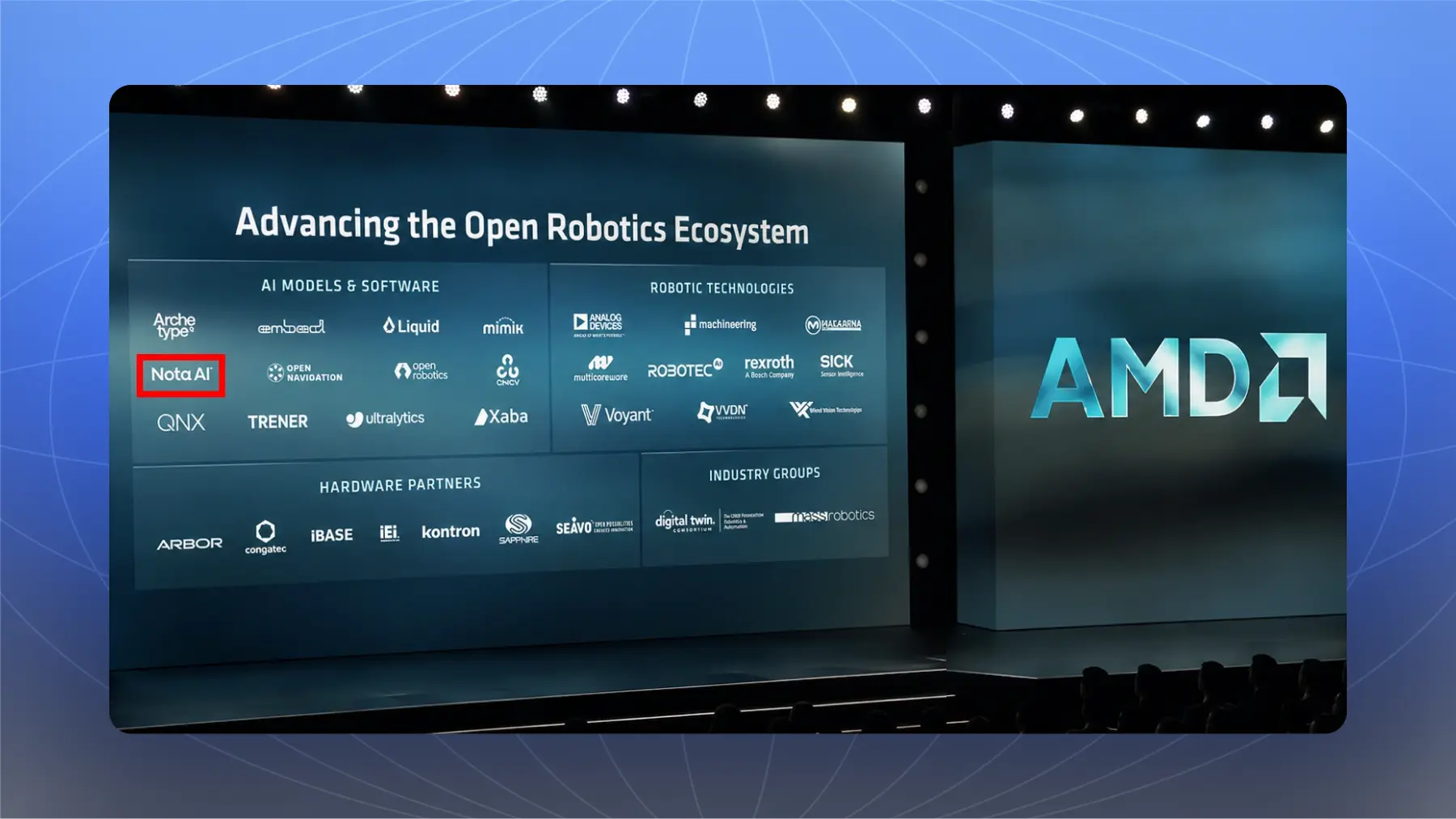
AMD officially unveiled its Robotics Partner Network during the "Advancing AI 2026" keynote in San Francisco on July 23 (local time). The network is an ecosystem for running AI on robots, and Nota AI is among the initial participants. Of the 24 companies listed in the AMD Robotics Partner Directory, Nota AI is the only Korean company.
AI that steps out from behind the screen into the physical world and moves within it is called Physical AI. When a semiconductor company talks about robotics in a keynote, it reads as a signal that the compute foundation is ready. This is not limited to AMD. NVIDIA unveiled an open humanoid robot at its CES 2026 keynote, where the Disney character Olaf walked out onto the stage and traded a few words with CEO Jensen Huang. On the point that AI's stage is moving from the cloud, past the PC, into the physical world, the semiconductor industry is speaking with one voice.
"The next era of AI will not just unfold behind the screen. It will unfold in the world around us."
Jack Huynh, Senior Vice President, Computing and Graphics, AMD
Looking at the partner network roster, you can see the statement was more than just words. Companies filled in each of the areas it takes to build a robot, and Nota AI sits in the AI model optimization slot. This article lays out why Nota AI is in that seat, and why optimization is the precondition for AI on the robot.
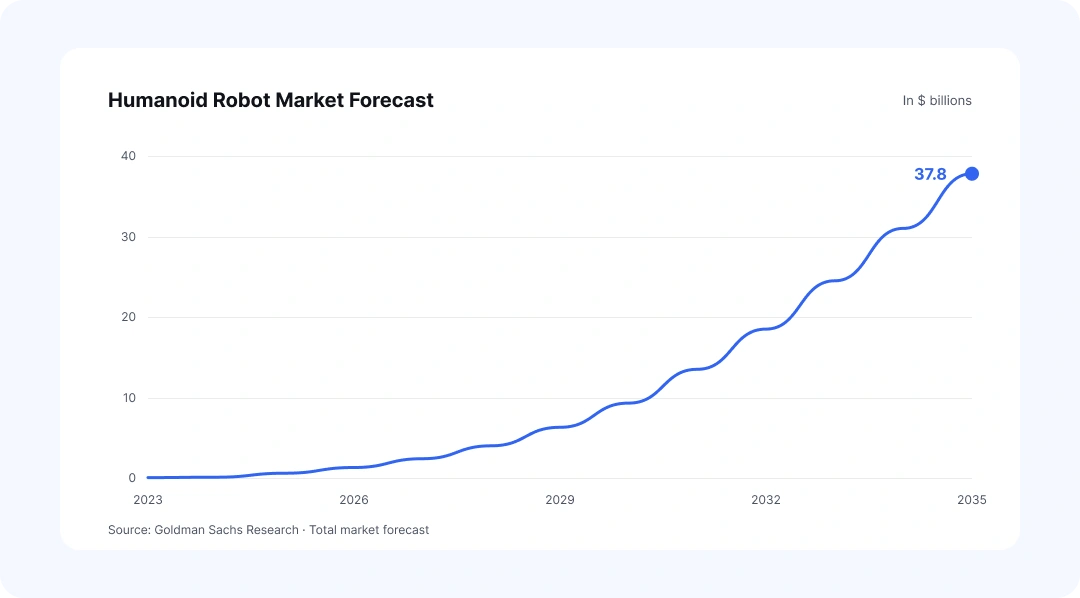
The way the robotics market is viewed is changing fast. Goldman Sachs raised its humanoid robot market forecast from $6 billion to $38 billion by 2035, more than a sixfold increase. That is the backdrop for AMD putting robotics front and center, and the Robotics Partner Network is how it acts on that.
The AMD Robotics Partner Network is an ecosystem that gathers, on top of AMD's compute technology, the layers needed to build a robot. What AMD emphasizes is openness. Rather than being tied to a single vendor, you can pick and combine partners across each hardware and software area.
The roster shown on the keynote screen splits into four areas: the AI models and software that handle a robot's intelligence; the robotics technology that covers sensors, actuation, and simulation; the hardware partners that build compute boards and modules; and the industry bodies responsible for standards and community. Nota AI's place is in AI models and software. Its role is to tune the AI models that have to run on the robot to fit that compute and memory environment.
Cloud AI and on-robot AI become entirely different problems even when they use the same model. The moment a model crosses over to the robot, three constraints appear.
First, the real-time control loop. The cycle from a robot perceiving and deciding to moving its joints runs in milliseconds. It leaves no room for a round trip to a server. This sits at a different layer than whether a network is present or not. Hybrid setups that keep part of perception or planning on a server exist, but any model that takes part directly in the control loop has to produce its answer on the robot.
Second, fixed compute and memory. A single robot has to carry a perception model, a pose estimation model, and a decision model together. You cannot add a card to expand resources the way you can on a server; the hardware on board is all there is. If one model grows even a little, another loses its place.
Third, power and heat. Compute is power draw, and power draw leads straight to run time and thermal design. A model that ran well in the lab hits battery life and heat-dissipation limits first in the field.
The three constraints point to one conclusion. A robot's intelligence ultimately comes down to how you run its model on the robot. It is also why, as semiconductor companies rebuild the robotics ecosystem, they place model optimization partners among the initial participants.
Within this network, Nota AI takes on AI model optimization. It uses quantization to cut a model's size and compute, and graph optimization to reshape it into a compute structure the target chip actually processes quickly. Even for the same model, the best combination changes depending on which chip it runs on. This is the work of meeting the three constraints above, one by one, on an actual board, and Nota AI plans to support the robotics partners through that process.
Nota AI's optimization experience is not tied to any single chip. From the tiny chips of the Arm Cortex-M family, to the NPU on edge SoCs, to the LPU on servers, it has validated its work directly in commercial projects. Joining the AMD Robotics Partner Network adds a robot-computing environment to that spectrum.
Nota AI has long worked on the problem of running AI outside the server: CCTV video analysis in smart cities, hazard detection on industrial safety sites, on-board inference in mobility. The domains differed, but the core problem was the same: putting perception and decision models on limited hardware while holding to real-world operating conditions. Robotics is an extension of that. The same holds for Computex 2026, where Nota AI was the only Korean company invited to the NVIDIA APAC Robotics and Edge AI Partner Day panel.
_03.webp)
The Nota AI page in the AMD Robotics Partner Directory notes that it supports optimization and deployment across CPU, NPU, and GPU targets, enabling "coverage of the full AMD portfolio."
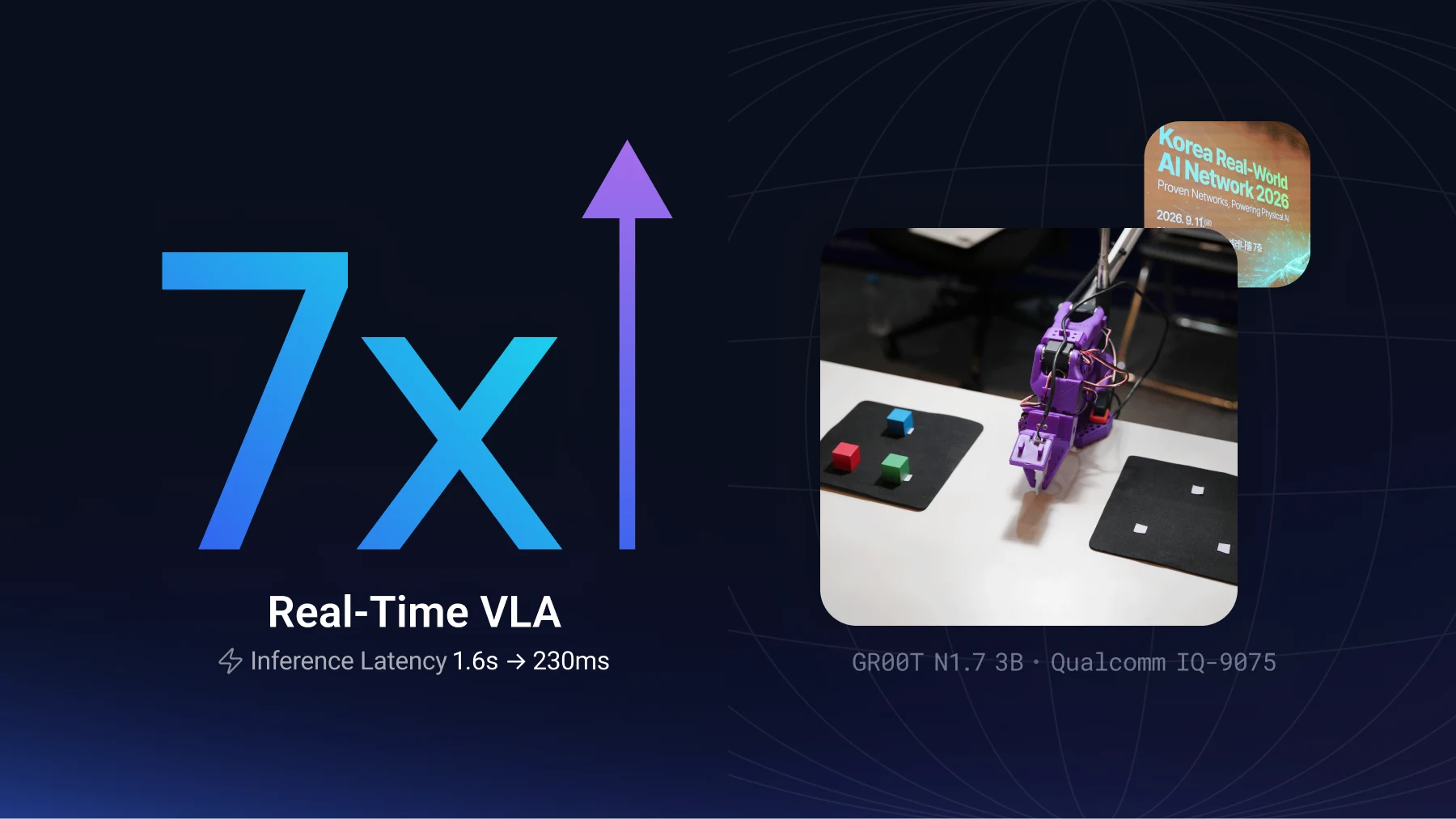
Nota AI has already solved this problem on real hardware. At the Nota AI booth at Embedded Vision Summit 2026, held this past May in Santa Clara, California, a robot arm given natural-language commands moved in real time on a Qualcomm Dragonwing™ IQ-9075 board, with no cloud connection. The SmolVLA model shown in the demo is a VLA (Vision-Language-Action) model that turns camera input and natural-language commands directly into joint movement. Because the model was not on the board's official support list, Nota AI ported it over itself.
_04.webp)
Measuring inference time by segment, the largest share came from the Action Head, which handles motion generation. Without retraining, Nota AI touched only this segment and cut its latency to one-seventh (218 ms → 31 ms), bringing total inference from 505 ms down to 310 ms. Because the upstream weights were left untouched, task success rate held to within 1 percentage point. This is why the robotics support is more than a plan.
A robot's intelligence is converging on VLA, and the models are growing to match. What used to be split across separate models for perception, decision, and control now falls to a single model. The three constraints above stay the same while only the model grows. The smarter a robot gets, the more there is for optimization to do. That optimization is the work Nota AI has taken on in the AMD Robotics Partner Network.
If you are at the stage of running Physical AI on real devices, you can see how the optimization works at NetsPresso.