
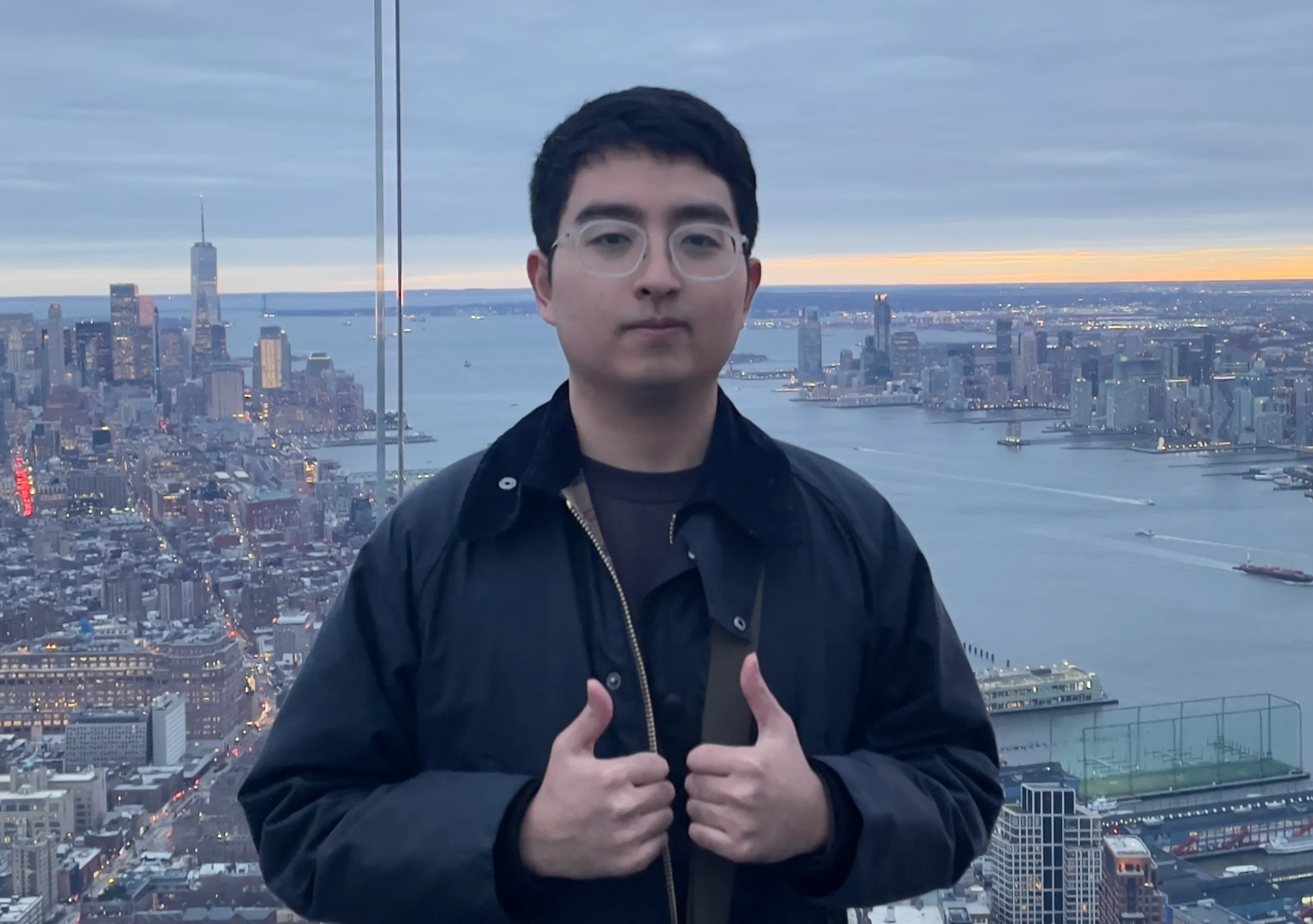
There's someone who won an NVIDIA hackathon and published a first-author paper at an ICML workshop, all within a single internship. That's Geonho Lee, who spent the past six months as a research intern on Nota AI's NetsPresso team. On the day before his last day, we sat down to talk about those six months.
A Familiar Office, Before Day One
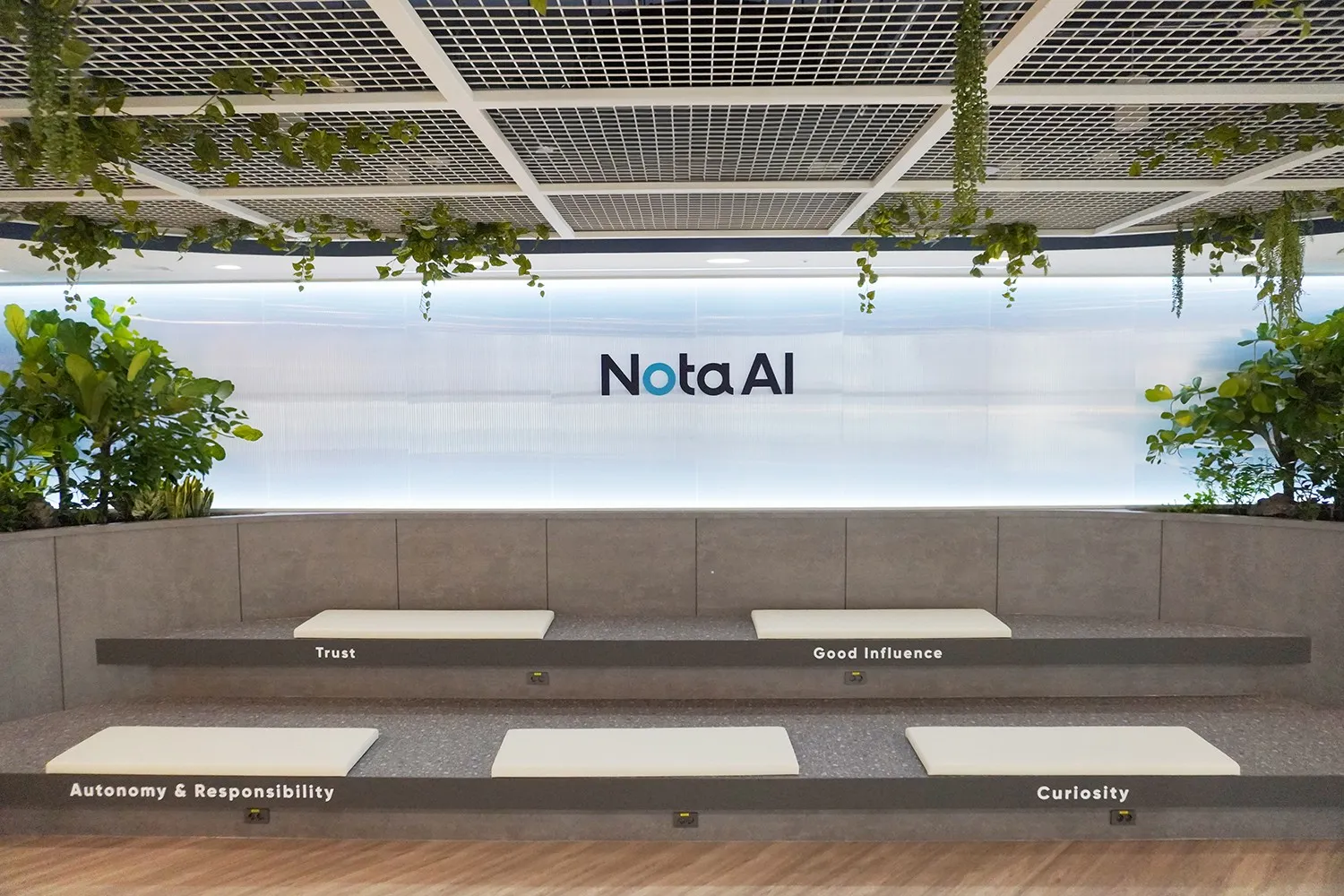
Two years ago, an exchange event between his lab and Nota AI brought Geonho to our office for the first time. Maybe that's why he seemed to have built a quiet familiarity with Nota AI long before he ever considered interning here.
"My first impression was really positive. The office was well set up, and the location near Samsung Station didn't hurt either. That good first impression ended up being one of the reasons I applied for the internship."

Geonho is a PhD student researching quantization in Professor Jungwook Choi's AIHA (AI Hardware & Algorithms) lab at Hanyang University. The lab focuses on solving bottlenecks in the AI era and has built a strong track record of research, including an NVFP4 paper at ICML. Coming from that background, Geonho had three reasons for deciding to intern at Nota AI: a chance to broaden his experience, exposure to real industry demand, and *MoE.
"In the lab, we mostly worked with dense models. MoE is a relatively difficult, still under-explored area, and the chance to work with it directly was really the deciding factor in applying for the internship at Nota AI."
So the office he'd once toured as a guest became the place where he clocked in as a team member, marking the start of both his first internship and his first taste of working life. Geonho joined right as Nota AI was entering the second year of a national research project, and having someone with his background come on board at that particular moment was a welcome development for us.
"During my internship, my main job was researching MoE lightweighting for the Sovereign AI Foundation Model, a national foundation model project."
As much as he looked forward to the work ahead, Geonho admitted to a tangle of other feelings too, wondering whether he'd measure up, and facing the nerves that come with trying something for the first time. Listening to him describe it, I recognized a lot of my own first day at Nota AI, and felt an unexpected kinship.
*MoE (Mixture of Experts) is an architecture that activates only the experts it needs for a given input, in contrast to dense models, which use their full set of parameters every time.
From Making Problems to Solving Them
In his first months of working life, Geonho found a clear difference between school and the workplace.
"In school, you define your own problem and solve it. At a company, you're solving a problem someone else has already defined. There's a fixed target, like compressing MoE within a certain performance drop, and you have to hit it. That kind of constraint was new to me. It didn't feel harder, exactly. It just felt different."
His view of practicality shifted too.
"In the lab, we tend to prioritize accuracy over latency. At the company, I immediately noticed how much weight goes into whether something actually runs on a serving framework like vLLM, the practical side of things. My very first task was comparing quantization formats across different serving frameworks."

There was a lesson in that.
"Putting in 100 units of effort to get to 99 points is important, of course. But at a company, there are a lot of moments where you need to get to 95 points quickly, with half that effort. That's a kind of expertise I hadn't really understood before."
Geonho's team is responsible for getting AI models running across a range of processors, or xPUs, including CPUs, GPUs, and NPUs. Compressing a model, deploying it to a device, and getting it to complete its task: that's all one continuous process. Being part of that process gave Geonho more than just technical experience.
"I came away convinced that what we're building is genuinely useful technology. There's real demand out there, and I could feel that we were building products for actual customers."
Two Months That Crawled By
Geonho's internship wasn't smooth sailing from start to finish. He admitted that for the first month or two, the research results weren't coming together the way he wanted, and it left him genuinely anxious.
"Early on, I felt like I was making no progress at all. I kept worrying I wouldn't have anything to show for the internship. Looking back, I think that feeling came from wanting to do well, and honestly, it's a completely normal part of the process. Trying a lot of different things is valuable in itself. You find the promising thread somewhere in all those attempts and grow it into a paper. At the time, though, I was just impatient."
Getting through that stuck period, Geonho relied on two approaches. The first was simply talking it through. Whenever he felt stalled, deep conversations with Hancheol, the colleague he worked most closely with, made a real difference.
"Hancheol and I talked through different ways of approaching the problem, and we made a point of sharing our perspectives openly. We sorted out what was feasible from what actually mattered, and what was quick to try from what would take real time. Lining things up against Hancheol's bigger picture, in particular, gave me a real thread to follow. Through all those conversations, we split up the work and I felt a real sense of reassurance, knowing we were both moving toward the same goal."
The second approach was changing his field of view.
"Early in the research, I kept the scope narrow and tried to examine things piece by piece. That didn't get me very far. So I zoomed all the way out and put everything on a single diagram, and that's where the questions and the breakthroughs surfaced. I built the rest of the research out from there."
It struck me that Geonho was only able to find those questions and breakthroughs because of the groundwork he'd already laid earlier on. Looking back on that stretch of time, here's the conclusion he landed on.
"I've come to believe that even when things feel stuck, if you keep digging with persistence, you'll eventually find the hint that leads somewhere good."
The NVIDIA Hackathon, and the Win
While working on the Sovereign AI Foundation Model project, Nota AI's ongoing collaboration with NVIDIA opened up an opportunity: a hackathon held as part of a dev day introducing NVIDIA's Nemotron ecosystem.
"There were three tracks to choose from, and I picked Dataset Generation. There was already prior research on improving MoE quantization performance from a dataset angle, and it was something our team had discussed more than once. I felt confident the ideas from the hackathon could feed directly back into the Sovereign AI Foundation Model project, and the company backed us fully, arranging accommodations and everything else, so we could focus entirely on preparing."
With so little time to produce results, the preparation itself was intense.
"We spent a lot of time asking what the limitations of existing research were, and where we could take a different approach. Since it was an NVIDIA competition, Hancheol suggested we lean on NVIDIA's own tools, so we scoped out what was available and how it could fit our idea ahead of time."
What Geonho took away from the process went beyond the technical.
"Watching Hancheol, I learned what it really means to sell an idea. I saw up close how he identified what the judges would respond to and pitched it that way. Companies have customers, and Nota AI has a Leadership Principle for that: Customer-Centric. In school, a presentation is about proving you're the best. In industry, you have to talk about how a technology gets used and how it gets sold."
It was a response that showed he'd gone a step further than just doing research. He was thinking about how to make the case for it.

Asked how much of the win was his, his answer said a lot.
"We worked through even the smallest details together, putting our heads together and reaching agreement as a team. It's hard to point to any one part and call it mine alone."
That collective effort ended in a win, and it fed directly into real progress on the Sovereign AI Foundation Model project.
What came after the win surprised Geonho more than the hackathon itself.
"I really felt the weight of NVIDIA's name. It's such a well-known company, and once NVIDIA Korea put out PR about it, people started recognizing it and reaching out on their own. My advisor congratulated me too. A lot of people found out I was interning at Nota AI because of this, and it ended up being something of a turning point."
Two Papers, One 100B Model
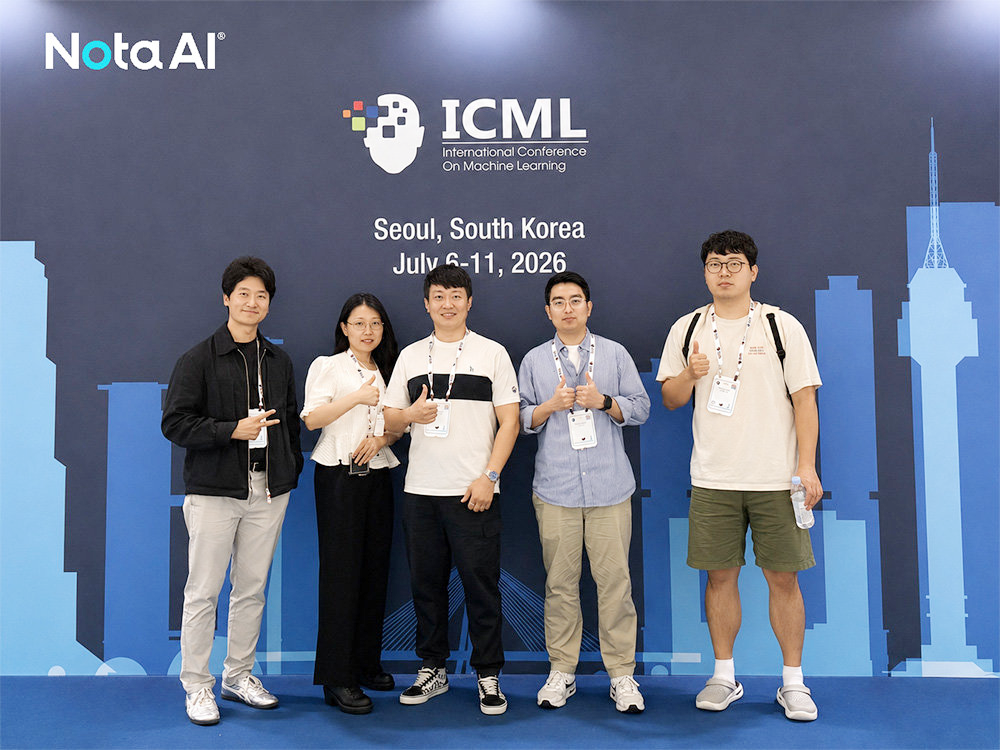
The MoE lightweighting research Geonho carried out for the Sovereign AI Foundation Model project became the foundation for two ICML workshop papers. Both deal with MoE routing, one with Hancheol as first author, the other with Geonho.
"The two papers started from different places. The goal was always to write two, one built around Hancheol's perspective, the other around my own approach and methodology. We each did our own research, but sharing feedback along the way is where the real synergy came from."
Reading each other's drafts was its own kind of training.
"When you're deep in writing a paper, you get stuck inside your own point of view. Things that feel completely obvious to you can be totally unclear to someone else. Learning to see your own work objectively is a skill in itself, and going back and forth with Hancheol's feedback again and again helped me sharpen that."
This was also research that would have been difficult to pull off outside a company.
"Models built for edge devices are usually just a few billion parameters. The Sovereign AI Foundation Model project works with models in the 100B to 200B range. Handling models at that scale takes GPU resources most labs simply don't have, and here I had access to far more than I would have in school. Academic labs often end up reporting on older or smaller models just because of resource constraints. Even looking at this year's ICML papers, very few report on 100B to 200B scale models. I was able to report on a 100B scale model, and I built the benchmarks around what's actually used in those models' own technical reports. None of that would have been possible without being at a company that works with AI at this scale."
When he heard the paper had been accepted, the feeling was closer to relief than celebration.
"Even a short paper can take months of work, and if it doesn't get accepted, you have to go through that whole stretch again. Mostly what I felt was relief that it was finally done."
No Longer Just an Intern
On paper, it was a striking six months. But talking with Geonho, what came up more often than the wins was the team. The hackathon win and the papers were both things he built alongside other people, and somewhere along the way, "colleague" started to fit him better than "intern." Looking at how he actually worked, it didn't match the usual picture of an intern. He built things through discussion and shared ownership, and within his own research, the decisions were his to make.
"My paper was mine from start to finish, so within my own research, I had full decision-making authority."
That mirrors Nota AI's Leadership Principle, Be Proactive. Asked whether that's something expected of interns specifically, his answer suggested it wasn't a requirement so much as a natural outcome.
"I think doing research just makes you proactive, almost by necessity. You have to get ahead of the problem to actually solve it."

Asked to name his most memorable day, he pointed to a team trip to Daebudo. They spent the day being active together, and also just sitting on the terrace, doing nothing in particular. No set agenda, just tracking planes across the sky and letting the hours pass.
"It was nice to just not think about anything. Being an intern didn't change how I was treated there. I was just part of the team."
Being able to spend a day on his own terms says something about how easily people settle into the culture here. That's also where Geonho pointed when asked what struck him most about the culture at Nota AI: transparency.
"Whether it's a channel or a meeting, most of what's happening gets shared openly. So even for work I wasn't directly involved in, I could usually tell what was going on just from the title. People from other teams weren't shy about commenting on or giving feedback on our work either, things like 'I should keep that in mind for my own work' or 'I can actually help with that.' That back-and-forth left an impression on me."
It's Trust and Step Out of Your Comfort Zone, two values Nota AI takes seriously, actually playing out in practice. Asked about his onboarding experience, here's what he said.
"I've never worked anywhere else, so I don't have anything to compare it to, but I could tell Nota AI puts real care into its people."
From Magnifying Glass to Wide Angle
When I asked what grew the most over his internship, Geonho pointed not to the visible wins, the NVIDIA win or the paper acceptances, but to the process behind them.
"Writing a paper completely on my own, start to finish. In school, professors and senior researchers help a lot with the framing. They've done it many times and know how to point you in the right direction. This time, I had to work out the storytelling and direction of the paper entirely on my own, and I really came to understand how a paper's narrative gets built. Just going through that thinking process alone was a huge experience in itself."
He said it'll change how he approaches research once he's back at school.
"I want to target the latest benchmarks and the latest models directly, and do research that actually makes an impact, the kind that scratches an itch people actually have."
I wondered if there was anything he wished he'd done differently, or what he'd want to try with another six months. His answers all pointed to what came just before or just after his own piece of the work.
"Since I was working on the Sovereign AI Foundation Model project, I expected I'd get to watch a model actually being built. But what we handled was compressing models that already existed. I would have liked to see the development process too. I'm curious about the other side as well. The team that turns a model into an actual service is a different thing entirely. Good benchmark numbers and a good service aren't the same. Research is about trying things repeatedly to find the best result. A service is more about not making a single mistake, even once, rather than doing well a hundred times. I'd like to experience what changes when technology moves past the research stage into an actual service."
To sum up his six months at Nota AI in one image, Geonho reached for a lens.
"School is a magnifying glass. Nota AI is wide angle. School lets you focus on one thing, but a company keeps moving with the field. Whenever a new model comes out, you catch what's changed and get straight to work. These six months moved faster, and covered more ground, than six months at school ever could."
His last words were for the next intern who joins Nota AI.
"In an AI landscape that's moving this fast, Nota AI might be one of the companies keeping pace with it best. Especially in lightweighting, we're right at the frontier, so I hope the next person gets to feel that speed for themselves."
The day after this interview, Geonho wrapped up his six-month internship and returned to the AIHA lab at Hanyang University. Nota AI is looking forward to meeting the next researcher who walks in wondering the same thing he did, whether the work they do here can actually be put to use.